
POS Inventory Sync That Stops Overselling
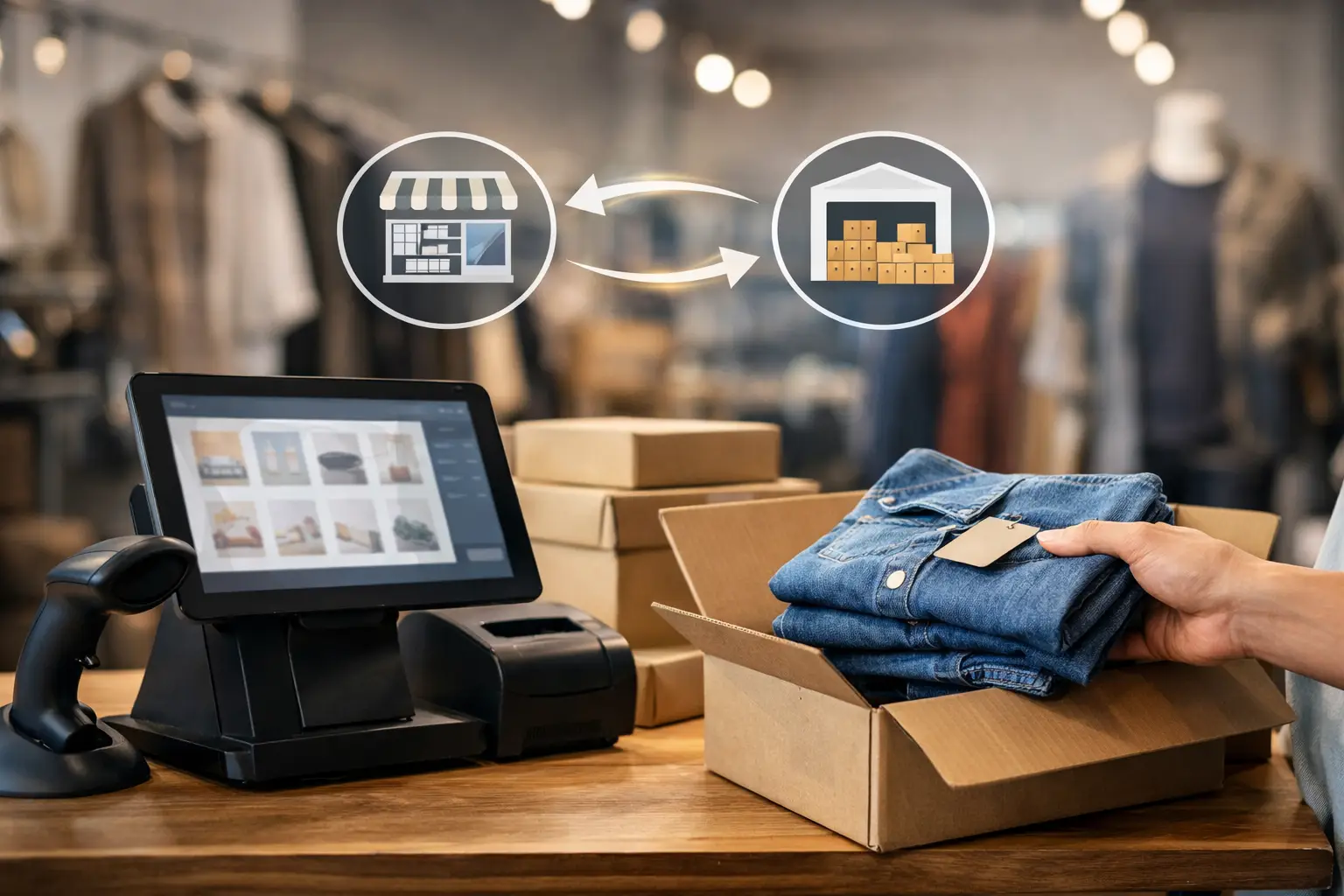
A customer buys the last available jacket in a physical store at 2:03 p.m. At 2:04, an online shopper adds that same jacket to their cart because the ecommerce site still shows one unit available. This is not a merchandising problem. It is a POS inventory sync problem, and it creates avoidable cancellations, support work, lost margin, and a weaker customer experience.
For retailers operating across stores, warehouses, marketplaces, and ecommerce channels, inventory accuracy is operational infrastructure. The right integration does more than move stock counts between systems. It defines which system owns inventory, how reservations are handled, what happens when data conflicts, and how quickly each channel can act on a sale.
Why POS Inventory Sync Fails in Real Operations
Most inventory problems are not caused by a missing API connection. They come from assumptions that work at low order volume but break as a business adds locations, fulfillment options, returns, bundles, or high-demand launches.
A basic setup may push a nightly inventory export from the POS to an ecommerce platform. That can be acceptable for a retailer with low online demand and a small catalog. It is not sufficient for a brand selling limited stock across multiple channels. A four-hour delay can produce dozens of orders for inventory that no longer exists.
The more difficult issue is that “inventory” rarely means one number. A retailer may track on-hand stock in the POS, available-to-sell inventory in an ERP, committed units in an order management system, safety stock in the ecommerce platform, and in-transit quantities from suppliers. If each system calculates availability differently, syncing the raw quantity does not solve the business problem.
Returns expose another common gap. A store associate may accept a return and put the item aside for inspection, while the POS immediately adds it back to available inventory. The ecommerce site then sells a unit that is damaged, incomplete, or not yet received at the fulfillment location. The integration is technically working, but the inventory rules are wrong.
Start With Inventory Ownership, Not Middleware
Before selecting an integration platform or writing custom code, define the source of truth for each inventory decision. In many established retail environments, the ERP or order management system should own enterprise inventory because it has visibility into purchasing, warehouse allocation, transfers, and fulfillment. In other cases, the POS is the most reliable source for store-level stock, while the ecommerce platform manages catalog presentation and channel-specific availability.
There is no universal answer. The right architecture depends on where orders are fulfilled, how transfers are recorded, and whether inventory is allocated centrally or by location. What matters is that each critical field has a clear owner.
A practical ownership model should establish who controls on-hand quantity, available-to-sell quantity, product status, location availability, and order reservations. Without this, two systems can overwrite one another in a loop. The POS updates stock after a store sale, the ecommerce platform adjusts inventory after an online order, and each sends its revised count back to the other. The result is stock drift that becomes difficult to diagnose.
A dependable design usually uses one-way authority for inventory balances, with controlled event flows in the other direction. For example, a store sale can be sent to the central inventory system as an event. The central system recalculates availability and publishes the updated sellable quantity to ecommerce channels. This adds a processing step, but it prevents competing systems from independently deciding what is available.
On-Hand Is Not the Same as Sellable
The inventory number shown to customers should usually be sellable inventory, not physical units on a shelf. Sellable inventory accounts for items reserved by unpaid orders, damaged stock, safety buffers, transfer commitments, and fulfillment rules.
Consider a retailer with ten units on hand in a store. Two are reserved for buy-online-pickup-in-store orders, one is held for a transfer, and two are kept as a safety buffer to protect in-store service. The ecommerce channel should not necessarily advertise ten units. It may be authorized to sell only five, or none, depending on the retailer’s allocation policy.
This distinction becomes especially valuable during promotions. Brands often increase paid traffic before verifying whether inventory reservations can keep pace with checkout volume. A clean storefront and a successful campaign can quickly expose weak allocation logic.
Design for Events, Delays, and Exceptions
Real-time POS inventory sync is often the goal, but it should be defined carefully. No integration is truly instantaneous. APIs have rate limits, webhooks can arrive late, background jobs can fail, and third-party platforms may temporarily reject requests. The engineering objective is not an unrealistic promise of zero delay. It is fast, observable, recoverable processing with rules that protect customer commitments.
For most commerce operations, inventory changes should move through event-driven updates. A completed POS sale, return, adjustment, transfer, purchase receipt, or order cancellation creates an event. The integration validates it, maps it to the correct SKU and location, updates the authoritative inventory system, and distributes the resulting availability to affected channels.
Each event needs an idempotency strategy. In plain terms, the system must be able to receive the same event more than once without subtracting inventory twice. Duplicate messages are normal in distributed systems, particularly when a network timeout leaves one system uncertain whether the other received the update.
The integration should also retain an audit trail. When a merchant asks why an item displayed as available at 9:17 a.m. but was canceled at 9:22, the team needs more than a current stock number. It needs the source event, timestamp, original quantity, transformed quantity, destination response, and any retry history.
Build a Reconciliation Process
Event processing reduces inventory drift. Reconciliation catches what event processing misses.
A scheduled reconciliation compares inventory balances between the source of truth and each connected sales channel. The cadence depends on transaction volume and risk. High-volume retailers may reconcile several times per day, while lower-volume businesses may use a daily process. The important point is that reconciliation should identify and resolve exceptions, not blindly overwrite every downstream count.
For example, a discrepancy might be caused by a SKU mapping error, a deleted location, a manually created adjustment, or an order that was imported without its reservation. Treating all mismatches as a simple quantity update can conceal the root cause and allow it to repeat.
Exception reporting should be understandable by operations teams. A useful report groups issues by location, SKU, age, and severity, then distinguishes between processing failures and legitimate business exceptions. A system that requires an engineer to interpret every inventory alert will become expensive to operate.
Account for the Workflows That Create Stock Risk
The strongest integrations are built around actual operating workflows, not an idealized order path. Store pickup, ship-from-store, partial fulfillment, exchanges, preorders, backorders, gift bundles, and product kits all change how availability should be calculated.
Bundles are a frequent source of errors. If a gift set consists of a candle, tray, and matches, the sellable bundle quantity is limited by the lowest available component. A POS that tracks only the finished bundle SKU may not communicate the component-level depletion required by an ecommerce fulfillment system. The integration must either maintain a reliable bill of materials or centralize bundle calculation in the system that owns inventory.
Location mapping deserves the same scrutiny. A physical store, a warehouse, a third-party logistics provider, and a virtual returns location should not be treated as interchangeable inventory pools. The ecommerce platform needs to know where stock can fulfill each customer promise, not simply where units exist.
Returns and exchanges require explicit rules as well. Decide when returned stock becomes sellable, whether it must pass inspection, and how exchange reservations are prioritized. These details are often handled informally at first. As order volume grows, they need to become system behavior.
Measure the Integration Like a Revenue-Critical System
POS inventory sync should have operating metrics, not just a launch checklist. Track inventory update latency from source event to channel availability, failed event rate, retry volume, reconciliation variance, oversell rate, and cancellation reasons. These measures reveal whether the integration is protecting revenue or only appearing to work.
A low oversell rate alone can be misleading if the business is using large safety buffers that suppress legitimate online sales. The goal is to balance accuracy and sell-through. If every channel is conservatively understocked, the retailer avoids cancellations but leaves revenue on the table.
Architecture choices matter here. Native connectors can be effective when workflows are standard and the data model is simple. Middleware can accelerate integrations across several platforms, but it may become restrictive when custom allocation, complex product relationships, or high event volumes are involved. Custom integration services require more upfront engineering, yet they often provide better control over performance, logging, and business rules for operationally complex retailers.
The correct choice is the one that supports the business’s current workflows without blocking the next stage of growth. A connector that works for one warehouse and two stores may not be the right foundation for ship-from-store, regional inventory allocation, and a new marketplace channel.
Reliable inventory is not a background technical detail. It is the condition that lets merchandising, marketing, store operations, and fulfillment make promises they can keep. Build POS inventory sync around ownership, events, exceptions, and measurable service levels, and inventory stops being a source of friction between channels.