
API Integration for Online Stores That Scale
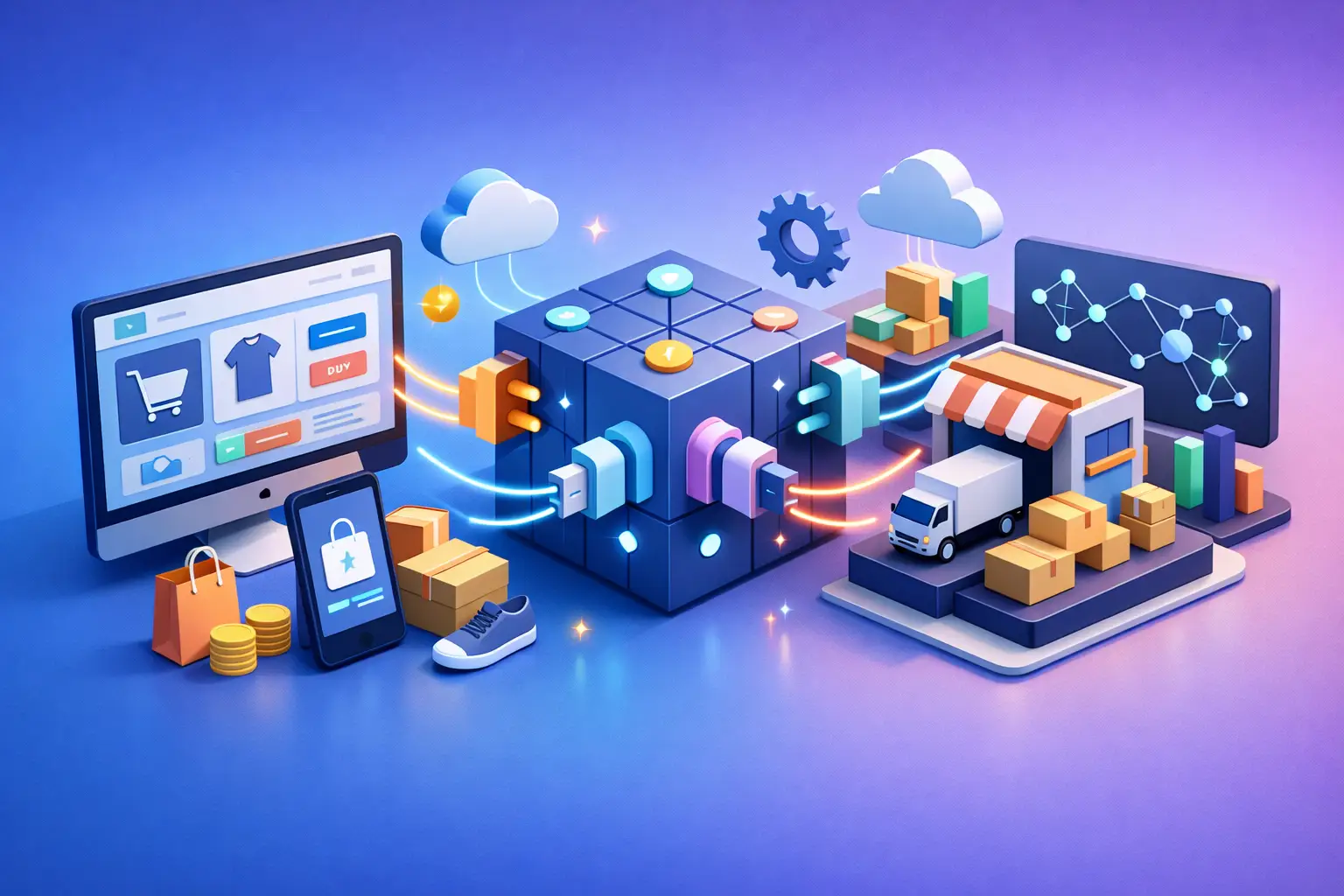
When an online store starts outgrowing spreadsheets, manual exports, and patched-together apps, the real problem is rarely the storefront. It is the system behind it. API integration for online stores is what turns disconnected tools into a working commerce operation - one where inventory, orders, fulfillment, customer data, and marketing activity move in sync.
For growth-focused brands, that shift is not a technical luxury. It is the difference between scaling revenue and scaling operational friction.
What API integration for online stores actually solves
Most established ecommerce businesses are not running on a single platform. They are running on a storefront, an ERP or accounting system, a warehouse or 3PL workflow, one or more payment providers, a CRM, marketing tools, subscription logic, returns software, and often a POS layer as well. Each system may perform well on its own. The trouble starts when data moves slowly, inconsistently, or not at all.
That is where API integration matters. An API allows systems to exchange data in a structured way. In commerce, that usually means pushing and pulling information such as product records, pricing, customer profiles, inventory availability, order status, shipping updates, and refunds.
The commercial value is straightforward. Teams spend less time correcting errors. Customers see more accurate stock levels. Orders route faster. Reporting becomes more reliable. Merchandising and operations stop working from different versions of the truth.
The deeper value is architectural. Good integrations reduce dependency on manual intervention and make the business less fragile. If every promotion, SKU update, and fulfillment event depends on someone exporting a CSV, growth creates risk. If those processes are automated through stable integrations, growth becomes more manageable.
Where online stores feel the pain first
The first signs are usually operational, not strategic. Inventory oversells because warehouse stock updates lag behind the storefront. Orders fail to sync cleanly into the ERP. Customer service teams cannot see a complete order history because key events live across multiple systems. Finance spends days reconciling transactions that should have been captured automatically.
At the same time, the customer experience suffers in subtle but costly ways. A shopper places an order for an item that was actually unavailable. Shipping timelines are inaccurate because fulfillment data is delayed. Personalized product logic breaks because a configurator is disconnected from the backend systems that should validate options and pricing.
These are not edge cases. They are common symptoms of a store architecture that was built for launch, not for complexity.
This is why API integration work needs to be evaluated as business infrastructure, not just development support. The objective is not merely to connect software. It is to reduce latency, improve data integrity, and remove bottlenecks that affect revenue and fulfillment performance.
Not every integration should be built the same way
One of the most expensive mistakes in commerce architecture is treating every integration as equal. They are not.
Some integrations are transactional and time-sensitive. Inventory syncing across multiple sales channels is a good example. If that data is delayed or unreliable, the business can oversell products and create immediate service issues. Other integrations are less time-critical. A nightly sync for certain finance or reporting workflows may be perfectly acceptable if the business does not require real-time visibility.
That distinction matters because it shapes implementation. Real-time API calls, event-driven architecture, middleware, queues, batch jobs, and fallback logic all serve different purposes. The right design depends on business tolerance for delay, error handling requirements, data volume, and downstream process dependency.
A mature implementation starts by asking practical questions. What data actually needs to move? How often? What happens when one system is temporarily unavailable? Which system is the source of truth for pricing, inventory, customer records, and order states? Without those decisions, integrations become fragile quickly.
This is also where platform neutrality matters. Shopify, Magento, BigCommerce, and custom stacks all support integration, but they do not offer the same flexibility, rate limits, data models, or extension patterns. A strong architecture is built around the business process first, then matched to the platform constraints and capabilities.
The systems that usually matter most
In most mid-market commerce environments, a few integration categories carry the most operational weight.
Inventory and order management are usually at the top of the list. If inventory is split across warehouses, stores, suppliers, or drop-ship partners, the storefront needs accurate availability data and the business needs clear allocation logic. That is rarely solved with a basic plugin.
ERP integration comes next for brands with serious operational complexity. Product data, purchasing, invoicing, customer accounts, and fulfillment often rely on ERP workflows that the ecommerce platform cannot replace. If the ERP and storefront are out of sync, the business starts paying for duplicate work.
POS integration becomes critical for omnichannel retailers. Shared customer records, unified stock visibility, and coordinated promotions all depend on reliable system communication. Without it, in-store and online teams operate as separate businesses.
Then there are custom workflows - product personalization, subscriptions, B2B pricing rules, account-based ordering, or operational tools built around the business. These often create the strongest competitive advantage, and they almost always require custom API work because the process is specific to the company.
Why off-the-shelf connectors often hit a ceiling
Prebuilt apps and middleware can be useful. For straightforward needs, they can save time and reduce upfront cost. But they also tend to break down when the business logic gets specific.
A connector may sync orders, but not handle split fulfillment correctly. It may push inventory, but not support reserve stock rules across channels. It may connect the ERP, but fail when product structures, bundles, custom attributes, or returns workflows fall outside the default model.
This is where many brands get stuck. The store is technically integrated, but operationally compromised. Teams start creating side processes to fix edge cases, and those edge cases grow with order volume.
Custom integration is not always the first answer, but it becomes the right answer when the business needs accuracy, control, and scalability more than convenience. The goal is not to build for the sake of building. The goal is to support the actual operating model of the business.
What good implementation looks like
Strong API integration for online stores is measured less by the number of connected systems and more by reliability under pressure. Peak traffic, promotion spikes, bulk catalog updates, returns surges, and warehouse exceptions reveal whether the integration is doing its job.
In practice, that means implementation should include monitoring, logging, retry logic, validation rules, and clear ownership of data. If an order fails to sync, the team needs to know quickly and resolve it without guessing. If inventory updates are delayed, the system should fail predictably rather than silently corrupting stock data.
Documentation matters too, especially for businesses planning to scale or replatform later. An integration that only makes sense to the original developer becomes technical debt fast. A documented, modular architecture creates options.
This is also why experienced agencies approach integrations through business scenarios, not just endpoint mappings. A technical connection is easy to overstate. The harder question is whether the system supports the edge cases that matter in live commerce operations.
The business case is bigger than efficiency
Leaders often justify integration work as an efficiency project, which is fair but incomplete. Better integrations do reduce manual work and lower error rates. They also support growth in less obvious ways.
They make channel expansion easier because inventory and order data can move consistently across marketplaces, stores, and geographic regions. They support better customer experience because order status, product availability, and account data are more trustworthy. They improve marketing execution because customer and product signals are cleaner. And they protect margin by reducing exception handling, failed fulfillment, and operational waste.
For some businesses, integration work also delays or avoids larger platform change costs. If the current commerce stack is fundamentally sound but operationally constrained by poor system communication, fixing the integration layer can create substantial performance gains without a full rebuild.
That said, there are cases where integration problems are symptoms of a deeper platform issue. If a business is pushing against core platform limits, using fragile workarounds, or carrying years of technical debt, integration alone will not solve the problem. It depends on whether the architecture is underconnected or structurally mismatched.
Choosing the right partner for API integration
For established brands, this work should not be scoped as a generic dev task. It requires a team that understands commerce operations, platform constraints, data architecture, and failure handling in real production environments.
That is why the best integration partners ask operational questions early. They want to understand order flow, warehouse logic, product complexity, customer account structure, reporting dependencies, and where current errors are costing time or revenue. They are not just mapping systems. They are designing an operating layer.
At Lantera, that usually means evaluating the whole commerce environment before recommending a solution. In some cases, a targeted integration fixes the bottleneck. In others, the right move is middleware, custom services, or a broader platform architecture change. The common thread is practicality: build the system that supports scale, not the one that looks simplest on a diagram.
If your team is still managing key workflows by hand, your store is already telling you where the next bottleneck is. The smartest time to fix it is before growth turns it into a revenue problem.