
What Is SaaS Development and How It Works
A lot of companies ask what is SaaS development when they reach the point where spreadsheets, manual workarounds, and off-the-shelf apps stop keeping up with the business. That usually happens fast in commerce. Orders increase, inventory gets split across channels, customer expectations rise, and suddenly the business needs software built around its operations instead of forcing operations to fit generic software.
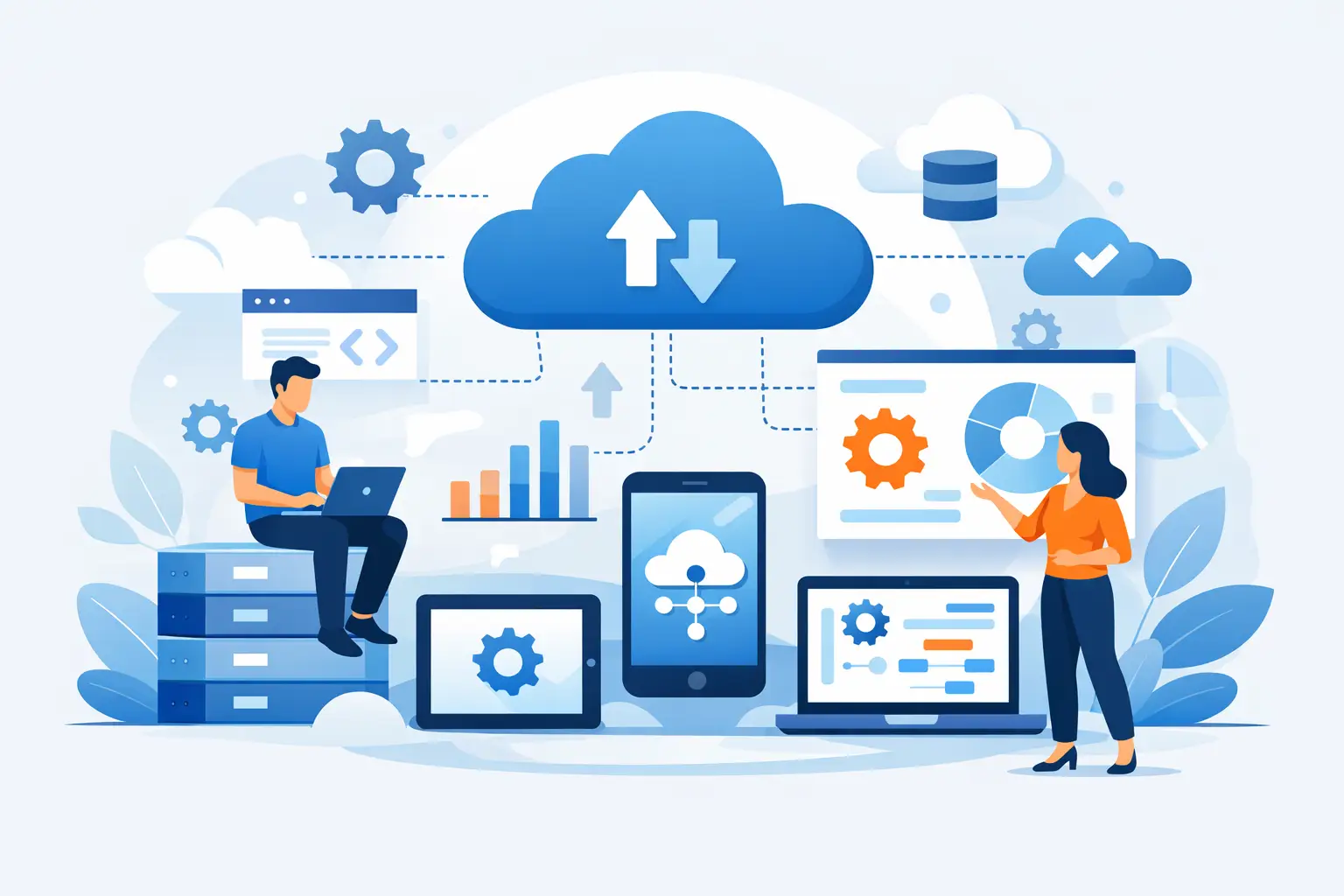
SaaS development is the process of designing, building, launching, and maintaining software that users access over the internet, typically through a browser or API, on a subscription basis. Instead of installing software on local machines or running it on a company’s own servers, customers use a centrally hosted application managed by the provider. The product is updated continuously, supported centrally, and structured to serve many users at scale.
That definition is simple. The real value sits in the delivery model.
What is SaaS development in practical terms?
In practical terms, SaaS development means building a cloud-based application that can support multiple customers, handle ongoing updates without disrupting users, and grow without requiring every customer to manage infrastructure. The work is not just writing application code. It includes product architecture, hosting strategy, security, billing logic, user permissions, data design, performance engineering, and long-term support.
For a commerce business, that could mean a product personalization engine, a merchant portal, a returns management platform, a custom B2B ordering system, or an internal operations tool delivered with the same reliability as a commercial software product. The difference between a basic web app and a real SaaS product is that SaaS is built for repeatable delivery, central control, and ongoing evolution.
A custom internal dashboard can be useful. A SaaS product is useful and operationally durable.
How SaaS development differs from traditional software development
Traditional software was often delivered as something installed on a local device or a company server. Updates were slower, deployments were more fragmented, and customers carried more responsibility for maintenance. SaaS changed that model by centralizing the application and shifting infrastructure, support, and upgrades to the software provider.
That creates clear advantages. Deployment is faster, feature releases are easier, and users can access the product from anywhere with the right credentials. It also creates stricter engineering demands. If the application fails, everyone feels it. If data models are poorly designed, scaling gets expensive. If integrations are weak, the product becomes another disconnected tool in an already fragmented stack.
This is why SaaS development is as much about systems thinking as feature delivery.
The core parts of SaaS development
Every SaaS product has its own requirements, but most serious builds include the same foundational layers.
The frontend is the interface users interact with, whether that is a browser-based application built in React or Next.js, a mobile app, or both. This is where usability matters. If a tool handles pricing, merchandising, fulfillment logic, or customer data, the interface has to support speed and accuracy, not just look polished.
The backend handles business logic, workflows, APIs, authentication, and system operations. In many projects, this is where the real complexity lives. A SaaS platform may need to process inventory rules, manage subscriptions, trigger automations, or sync with external systems such as ERPs, POS platforms, CRMs, and eCommerce platforms.
The database layer stores customer, operational, and transactional data. This is not a minor detail. Bad data architecture becomes expensive later, especially when reporting, permissions, and integrations become more demanding.
Then there is cloud infrastructure. SaaS products are usually hosted in cloud environments that allow the application to scale, recover from failures, and support continuous deployment. Infrastructure decisions affect speed, reliability, security, and operating cost.
Finally, there is the product layer around the software itself: onboarding, billing, analytics, support tooling, user management, and compliance controls. A working app is not automatically a viable SaaS business.
Multi-tenant vs single-tenant architecture
One of the most important architecture decisions in SaaS development is whether the platform is multi-tenant or single-tenant.
In a multi-tenant model, multiple customers use the same core application and infrastructure while their data remains logically separated. This is the most common SaaS approach because it is efficient to maintain and scale. Updates are easier to roll out, infrastructure use is more efficient, and operating costs are usually lower.
In a single-tenant model, each customer has a more isolated environment. That can make sense for enterprise requirements, strict compliance needs, or highly customized implementations. The trade-off is cost and maintenance overhead. More isolation can mean less efficiency.
There is no universal right answer. If you are building a product for broad market adoption, multi-tenant architecture is often the stronger model. If your customers have unusual security or integration requirements, a hybrid or single-tenant approach may be justified.
Why SaaS development is attractive for commerce businesses
Commerce operations are full of repeated processes, edge cases, and integration gaps. That makes them a strong fit for SaaS products.
A retailer might need software to manage bundled products across multiple warehouses. A brand might need a subscription management layer that fits its pricing model better than standard apps. A distributor might need a self-service ordering portal tied directly to customer-specific pricing and ERP data. These are not abstract software ideas. They are operational bottlenecks that affect revenue, speed, and margin.
SaaS development gives businesses a way to turn those bottlenecks into scalable systems. Instead of relying on disconnected plugins and manual intervention, the company gets software designed around how it actually sells, fulfills, and serves customers.
That said, custom SaaS is not automatically the right move. If an existing product already solves the problem well and fits the stack, buying is usually smarter than building. Development makes sense when the workflow is strategically important, the process is too specific for generic tools, or the long-term gains justify the investment.
What the SaaS development process usually looks like
Strong SaaS development starts with requirements and architecture, not design mockups. The first step is understanding the business process, user roles, data flows, integration points, and scale expectations. If those are unclear, teams end up building features instead of building a product.
Next comes technical planning. That includes application structure, infrastructure, security, tenancy model, and technology selection. The stack should fit the product, not the other way around. In some cases Laravel is a strong backend choice. In others, a more service-oriented architecture is better. The same applies on the frontend.
After that, teams move into interface design and implementation. Early releases often focus on a minimum viable product, but that does not mean cutting corners on architecture. A lean first version should still be built on foundations that can scale.
Testing is critical throughout. SaaS products need functional testing, performance testing, security review, and deployment discipline. Once the product is live, the work shifts toward iteration, monitoring, support, and optimization. SaaS is not a launch-and-leave model. It is an operating model.
Common challenges in SaaS development
The biggest mistakes usually come from underestimating complexity.
Teams often focus too heavily on features and not enough on permissions, auditability, data structure, and integration behavior. Those details matter more as the product grows. A tool with weak access controls or brittle third-party sync logic becomes risky fast.
Another common issue is building for a single use case while assuming the product can later become a broader platform. Sometimes it can, but sometimes the early architecture makes that expensive. If the long-term goal is productization or multi-client delivery, that needs to shape the build from the start.
Cost control is another factor. SaaS products can become expensive to operate if infrastructure, queries, file storage, or external API usage are not managed carefully. Growth is good, but growth on inefficient architecture creates margin problems.
How to evaluate whether you need SaaS development
If the problem is central to your operation, repeated across teams or customers, and poorly served by current tools, SaaS development may be worth serious consideration. The same is true if your team is spending too much time patching together manual processes or forcing multiple systems to behave like one platform.
What matters is not whether the idea sounds innovative. What matters is whether the software will reduce friction, support scale, and produce measurable business value. In a performance-focused environment, that usually means faster execution, fewer operational errors, cleaner data, better customer experience, or a stronger ability to expand.
For complex commerce businesses, the right SaaS product can become core infrastructure rather than just another app. That is where technical discipline matters most. The architecture has to support the business you are running now and the one you expect to run two years from now.
A good SaaS product does not just digitize a task. It gives the business a more reliable way to operate, adapt, and grow. That is the standard worth building toward.